Man Cave Buyers Guide is a participant in the Amazon Services LLC Associates Program. If you buy through links on this page we may earn a commission, at no extra cost to you. We do not accept manufacturer samples or payment for favorable coverage.
Basement bars live and die on lighting. Get it wrong and even a beautifully built bar looks like an unfinished storage room after dark. Get it right and a modest corner reads like a proper pub. This guide walks through basement bar lighting ideas that balance ambience, task lighting, and personality, and shows how to plan the layers rather than just buying whatever pendant looks good online.
Quick answer: The strongest basement bar lighting ideas combine three layers: dimmable ambient light for the room, focused task lighting over the bar top and taps, and accent or signage lighting for atmosphere. Put each layer on its own switch or smart control so you can adjust them independently as the mood changes.
The Three-Layer Framework for Basement Bar Lighting
Most basement bars fail for the same reason: someone installs one type of light and expects it to do every job. A single set of recessed ceiling cans will light the room evenly but flatten everything, making the bar look clinical rather than inviting. A framework that separates lighting into distinct layers solves this without much extra cost.
Ambient layer
This is your base light, usually ceiling-mounted cans, flush mounts, or a central fixture, set on a dimmer. Its job is to make the room safely navigable, not to look interesting. As a rule of thumb, basements benefit from slightly warmer colour temperatures (around 2700K to 3000K) than a kitchen or office, since cooler white light tends to read as sterile in a below-grade space with little natural light.
Task layer
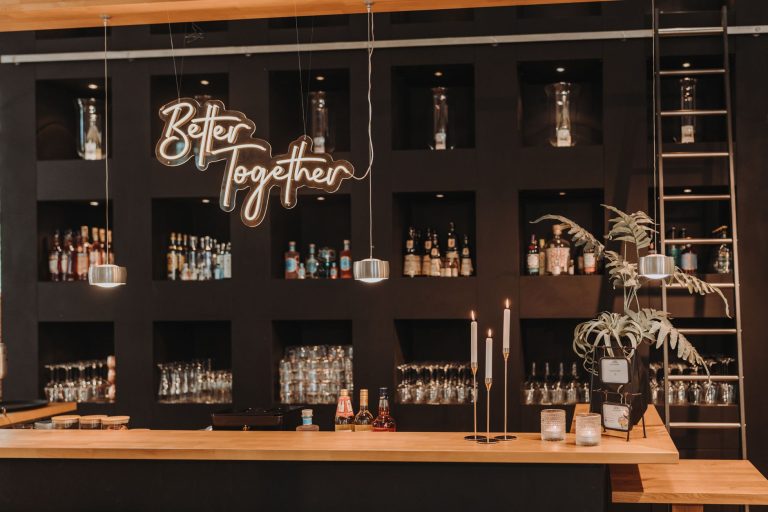
Task lighting covers the bar top, the pour station, and anywhere you are reading labels or mixing drinks. Under-cabinet strips, small puck lights, or a low-hanging pendant aimed at the work surface all qualify. This layer should be brighter and more direct than the ambient layer, and ideally on its own switch so you can kill it when the bar is not in use.
Accent and signage layer
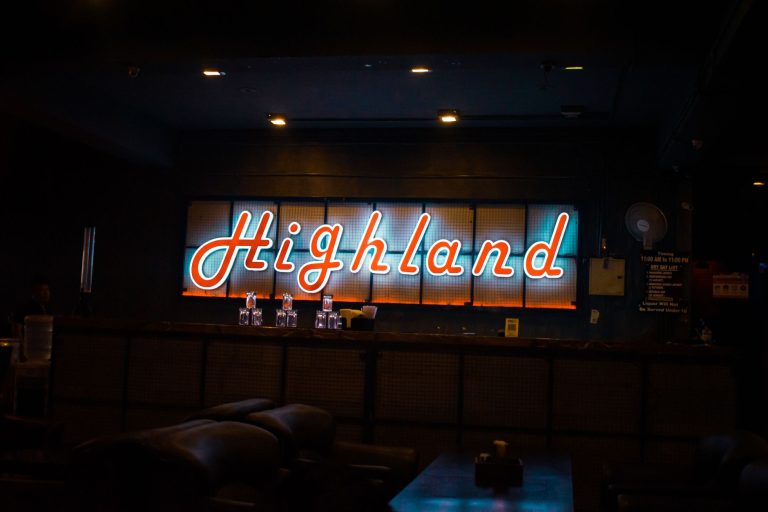
This is where personality lives: LED strips behind bottles, backlit shelving, sconces on brick or panelled walls, and signage. It is also the layer most people skip, which is exactly why so many basement bars look unfinished. A well-placed neon or LED sign does more to establish a bar’s character than almost any other single fixture, and our neon sign buying guide covers what actually holds up over years of use versus what fades or fails early.
Basement Bar Lighting Ideas by Area
Once the three-layer logic makes sense, it is easier to place specific fixtures with intent rather than guessing.
Over the bar top
Pendant lights spaced evenly above the bar are the classic choice, and they double as a design statement. Check the spec sheet on any pendant for recommended mounting height, but plan for roughly 30 to 36 inches between the bottom of the fixture and the bar top as a starting point, then adjust based on your own ceiling height and how tall your regular guests are.
Under the bar and back bar
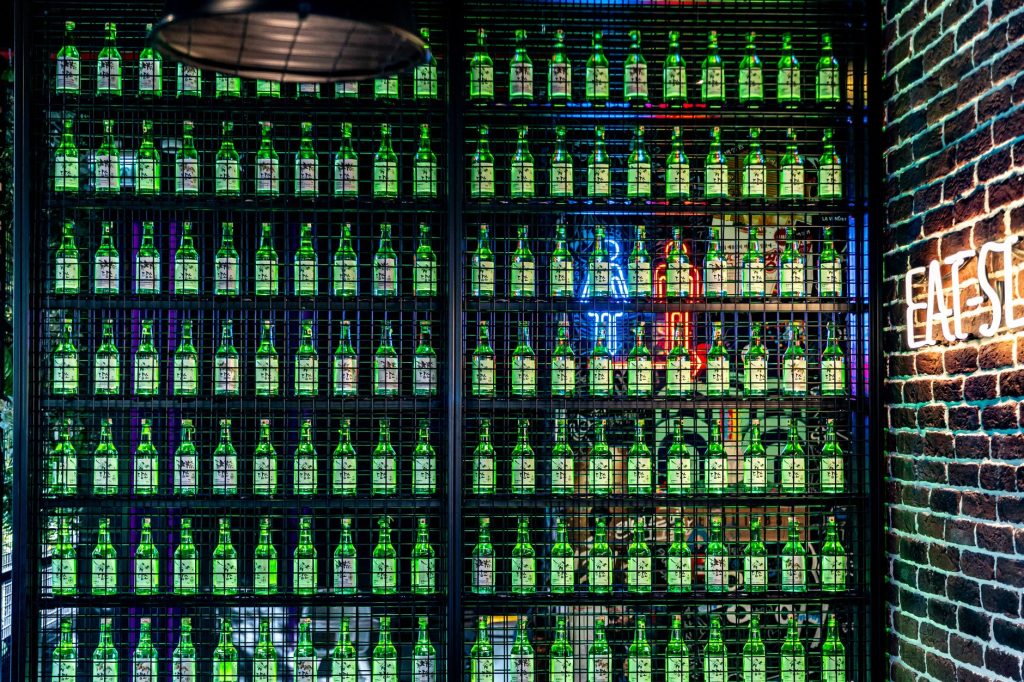
LED strip lighting tucked under the bar lip or along back-bar shelving gives a soft glow that makes bottles and glassware look considerably better without adding glare. Look for strips with a remote or app control so you can shift colour and brightness for different occasions rather than committing to one static look. A quick search for LED strip lighting kits will turn up options at very different price points, so compare brightness ratings and whether the adhesive backing suits your shelving material before buying.
Seating and lounge zones
Away from the bar itself, floor lamps, wall sconces, or a couple of table lamps keep seating areas from feeling like an afterthought. Basements often have low ceilings, so wall-mounted fixtures free up floor space and avoid the shadow-casting problem that a single overhead light creates in a long, narrow room.
Signage and personality
Neon or LED signs, string lights, and novelty fixtures belong in this layer. They are not meant to light the room, they are meant to give it character. Placement matters more than most people expect: a sign mounted at eye level behind the bar reads very differently to the same sign tucked in a corner. Our wall decor guide has more on positioning decor pieces so they anchor a room instead of competing with each other.
Matching Lighting to Your Room’s Size and Ceiling Height
Basements vary enormously, so a lighting plan that works for a 10 by 12 foot nook will not suit an open 400 square foot layout. As a general planning approach:
- For low ceilings, commonly under about 7.5 feet in older basements, favour flush mounts and wall sconces over hanging pendants, and measure your actual clearance before ordering anything that hangs down.
- For open-plan basements, plan for multiple ambient fixtures on a single dimmer circuit rather than one oversized light, since basements rarely have windows to bounce light around and dark corners show up quickly.
- For narrow bar counters, keep pendant spacing tighter, roughly every 24 to 30 inches is a common starting point, but check your own counter length and adjust so the spacing looks even rather than following a fixed number.
- For rooms with painted brick, panelling, or dark flooring, budget for slightly more total light output than you would in a room with pale walls, since dark surfaces absorb more light than they reflect.
Common Mistakes When Lighting a Basement Bar
- Relying on one ceiling fixture for the whole room, which leaves the bar top either too dim or the rest of the room too bright by comparison.
- Choosing cool white bulbs throughout, which can make a basement feel more like a garage than a bar.
- Skipping dimmers entirely, so the room only has one setting: fully on.
- Forgetting task lighting at the pour station, which makes measuring and reading labels harder than it needs to be.
- Treating signage as decoration only, rather than planning its placement as part of the overall light plan.
FAQ
What is the best lighting for a basement bar?
There is no single best fixture. The strongest setups layer ambient, task, and accent lighting on separate controls, so the room can shift from bright and functional to dim and social depending on the occasion.
How many lumens do I need for a basement bar?
This varies with room size, ceiling colour, and how much natural or reflected light the space already has. As a starting point, many lighting guides suggest planning ambient lighting around general living-room brightness levels and adding brighter, focused task lighting over the bar itself, but confirm output figures against the manufacturer’s spec sheet for your specific fixtures.
Should basement bar lighting be warm or cool white?
Warm white, generally in the 2700K to 3000K range, tends to suit basement bars better than cooler tones, since it reads as inviting rather than clinical in a room with little or no natural light.
Do I need an electrician for basement bar lighting?
For simple additions like plug-in LED strips or lamps, no. For new switches, dimmer circuits, or recessed lighting tied into your home’s wiring, hire a licensed electrician, both for safety and because most local codes require it for basement renovations.
Final Recommendation
Start with the three-layer framework before buying a single fixture: ambient for safety and general use, task for the bar top, and accent or signage for character. Fixtures are easy to swap later, but a poorly planned circuit layout is not, so decide early which layers need independent switches. For the wider room, our basement decor guide covers how lighting fits alongside flooring, seating, and wall treatments for a finished, cohesive space.