Man Cave Buyers Guide is a participant in the Amazon Services LLC Associates Program. If you buy through links on this page we may earn a commission, at no extra cost to you. We do not accept manufacturer samples or payment for favorable coverage.
The bar top is the one surface in a man cave that gets touched every single time someone walks in. It takes condensation rings, dropped bottle caps, elbows, spilled beer, and the occasional cigar. It is also the surface people photograph. Getting it right matters more than almost any other build decision, and the material you choose determines how much maintenance you sign up for over the next decade.
Here is an honest comparison of the four materials people actually use, and what each one asks of you after installation day.
Butcher block: warm, workable, and the most forgiving to install
Butcher block is the default for good reason. It is available at any home center, cuts with tools you probably own, and looks appropriate in almost every man cave aesthetic from industrial to traditional pub.
What it gets right: the warmth is genuine rather than printed, and it is the only option on this list a reasonably confident DIYer can fabricate start to finish in a weekend. Damage is repairable. A deep scratch or a burn mark sands out, which is not true of any other material here. Overhangs and curved fronts are straightforward.
What it asks of you: a decision about finish, and then ongoing attention. Oil finishes look and feel superb but offer little protection against water rings and need reapplication periodically. Film finishes such as polyurethane or conversion varnish protect far better but change the surface from wood to plastic-under-glass, and they scratch in a way that does not spot-repair cleanly.
Wood also moves with humidity, which matters in a basement. Let the slab acclimate in the room for at least a week before final fastening, and use fasteners that allow for seasonal expansion across the grain rather than pinning it rigidly.
Browse butcher block countertops on Amazon
Bar top epoxy: the deep-pour look, and the least forgiving process
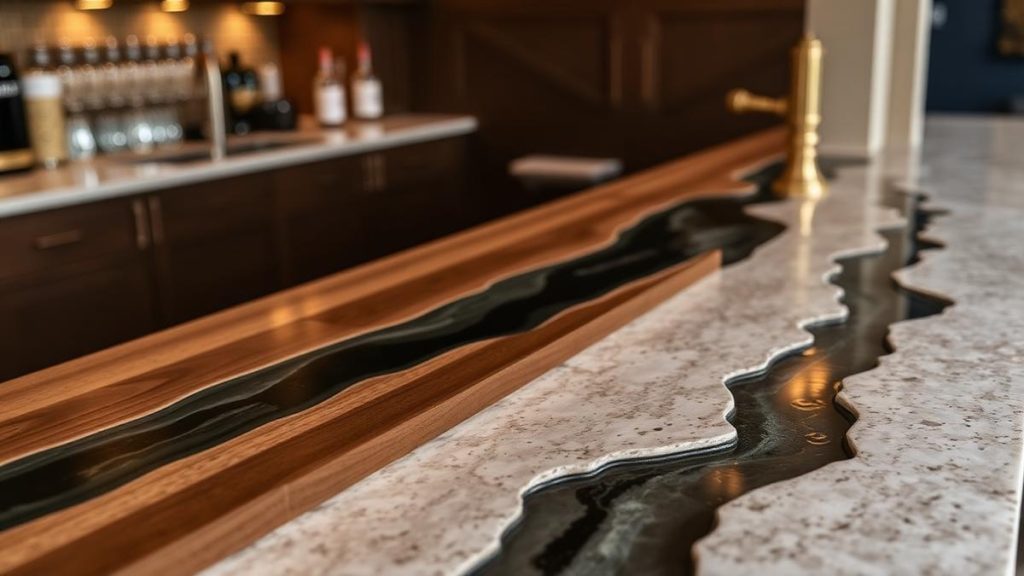
Epoxy is what people picture when they imagine embedding bottle caps, team memorabilia, or a poker felt under glass. Poured correctly, it produces a thick, seamless, genuinely waterproof surface with real visual depth.
What it gets right: total water resistance, heat tolerance well beyond what a cold drink demands, and a look nothing else replicates. It also lets you build a top over an inexpensive substrate, so material cost can be low relative to the result.
What it asks of you: discipline, and a tolerance for permanence. Epoxy is unforgiving in specific ways worth knowing before you open the kit:
- Temperature drives everything. Cold slows or stalls the cure and traps bubbles. Basements are frequently too cold. Bring the room and the resin to the manufacturer’s specified range and hold it there through the full cure.
- Mixing is not approximate. Off-ratio epoxy can stay tacky permanently. Measure by the method the manufacturer specifies, and scrape the sides and bottom of the container.
- Dust is the enemy. Anything airborne during cure is embedded forever.
- It is not repairable. A deep scratch cannot be sanded out without refinishing the entire surface.
Also worth knowing: epoxy is comfortably heat resistant for drinks but not for hot cookware, and prolonged direct sunlight can yellow some formulations. Neither is usually an issue in a basement.
Compare bar top epoxy kits on Amazon
Stone: the lowest-maintenance option, and the hardest to change your mind about
Granite and quartz both belong in this conversation, and they behave differently enough to separate.
Quartz is engineered, non-porous, and needs no sealing. For a bar surface that will meet red wine, citrus, and whiskey, that is a meaningful advantage. It is highly scratch resistant and consistent in appearance because it is manufactured rather than quarried.
Granite is natural stone and porous to varying degrees, so it requires sealing on a schedule that depends on the specific slab. In exchange you get genuine variation, and remnant slabs are frequently available at a steep discount, which matters because a bar top is small enough to be cut from another job’s leftovers. Ask fabricators about their remnant yard.
What both ask of you: professional fabrication, accurate templating, and structural support. Stone is heavy enough that your bar framing needs to be built for it, and it is entirely unforgiving of a measurement error, since the cut happens off site.
Laminate and the budget path
Modern laminate is far better than its reputation, and for a first build on a tight budget it is a legitimate choice rather than a compromise. It is inexpensive, comes in convincing patterns, and installs easily.
Its real limitations are edges and heat. The seam at a post-formed edge is where water eventually gets in and swells the substrate, and laminate is the least heat tolerant surface here. If you go this route, seal every cut edge carefully and treat the surface as genuinely damage-intolerant.
How to actually choose
Pick by the constraint that binds hardest:
- You want to build it yourself this month. Butcher block. Nothing else is as forgiving of a first attempt.
- You want the showpiece and will follow instructions exactly. Epoxy over a wood or plywood substrate.
- You want to never think about it again. Quartz.
- You want the look of stone at a discount. Granite from a remnant.
- The budget is genuinely tight. Laminate now, replace later. The bar framing does not change.
Details people get wrong
- Overhang. Plan roughly 10 to 12 inches of clear knee space for anyone sitting at the bar. Too little and stools become decorative.
- Support. Overhangs past about a foot need brackets or corbels regardless of material. Stone especially.
- Height coordination. Standard bar height and counter height take different stools. Decide the surface height before buying seating, not after.
- Cutouts first. Sinks, kegerator towers, and undercounter appliances must be planned before fabrication.
- Acclimation. Any wood product needs time in the room’s humidity before final installation.
The short version
Butcher block is the best all-round first bar top: affordable, repairable, and buildable with ordinary tools. Epoxy is the right call when the surface itself is meant to be the feature and you will respect the process. Quartz wins outright if you value never maintaining it. And laminate is a perfectly reasonable placeholder that lets you finish the room now and upgrade the top later without rebuilding anything underneath.