
Man Cave Buyers Guide is a participant in the Amazon Services LLC Associates Program. If you buy through links on this page we may earn a commission, at no extra cost to you. We do not accept manufacturer samples or payment for favorable coverage.
Furnishing a basement home theater is not the same job as furnishing a living room. You are dealing with narrow stairwells, lower ceilings, concrete floors, and a room that sits below grade where moisture behaves differently. Getting basement home theater seating right means solving for the space before you fall in love with a style.
Quick answer: Pick seating that fits through your stairwell and doorways, use moisture-resistant materials (leather match or performance fabric over natural leather or suede), choose low-profile recliners or risers if your ceiling is under 8 feet, and buy modular pieces so you can adjust the layout later without replacing anything.
The Basement Seating Fit Test
Before you shortlist any product, run through this four-point check. It solves the problems generic seating guides skip because they assume a ground-floor room.
1. Measure the route, not just the room
Basement stairwells are the number one reason seating gets returned. Measure the narrowest point of your staircase, any turns or landings, and every doorway between the delivery entrance and the theater room. A large sectional or a fixed-frame theater sofa that will not bend around a landing is a wasted purchase. Modular seating that arrives in separate seats or breaks down into smaller sections is almost always the safer bet for a basement.
2. Check your ceiling height before buying risers
Stadium-style tiered seating looks fantastic in photos, but a riser platform can eat 8 to 12 inches of headroom. If your basement ceiling sits at or below 8 feet, or you have ductwork and beams hanging lower, skip the riser and stick with a flat layout using recliners with a slightly reclined seat height instead.
3. Factor in below-grade moisture
Even a finished, dehumidified basement runs more humid than the rest of the house, especially in summer. This affects material choice more than most buyers expect, and it is worth reading before you fall for a beautiful top-grain leather set.
4. Plan the layout around the screen, not the walls
Basements often have awkward support columns or a furnace closet that forces an off-centre screen or projector position. Decide where the screen goes first. If you have not settled that yet, our short throw projector buying guide is worth reading in parallel, since projector placement and seating rows need to be planned together.
Basement Home Theater Seating Styles Compared
- Individual recliners: Best for small to mid-sized rooms and tricky stairwells, since each unit ships separately. Easiest to fit through a basement doorway.
- Modular theater seating with consoles: Rows of connected recliners with a fixed console between seats, often including cupholders and storage. Good middle ground between comfort and structured rows.
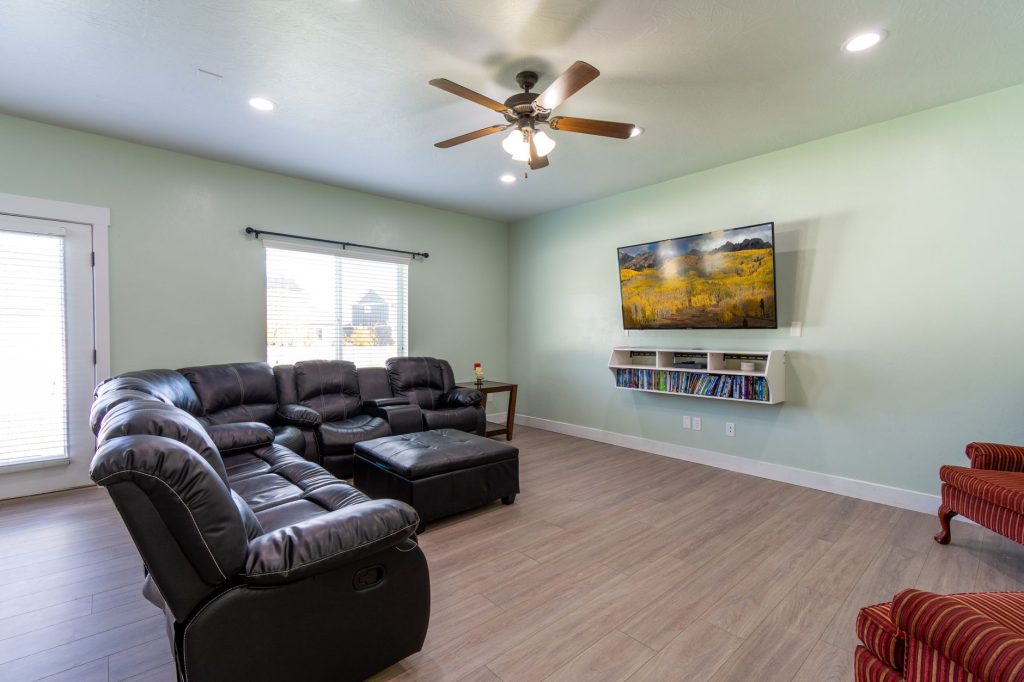
- Sectional sofas: More casual and social, better for basements doubling as a family room rather than a dedicated cinema. Harder to manoeuvre down stairs if it is one large fixed piece.
- Stadium risers with theater chairs: The most authentic cinema feel, but only realistic in basements with 9-foot-plus ceilings and a room built specifically for that purpose.
For most basement conversions, a row of connecting recliners strikes the best balance of comfort, fit and budget. You can browse current options for home theater recliner seating to compare widths and reclining mechanisms before deciding on a layout.
Materials That Actually Hold Up Below Grade
Natural leather and suede are the two materials most likely to disappoint in a basement over time. Leather can crack in a room with fluctuating humidity, and suede holds moisture and odour. Bonded leather and leather match (a mix of genuine leather on contact areas with a matching synthetic elsewhere) tend to perform more consistently in a below-grade room, and they are usually the more budget-friendly choice too.
Performance fabric, the kind used in outdoor and marine furniture, is worth serious consideration for a basement theater. It resists moisture, wipes clean, and does not develop the musty smell that untreated fabric can pick up over a few humid summers. If spills from drinks or snacks are a regular feature of your setup, this is the more sensible long-term choice over anything with a plush or velvet finish.
Whatever material you choose, check that the frame is kiln-dried hardwood rather than particleboard. Basements see more temperature swings than upstairs rooms, and particleboard frames are more prone to warping over several years.
Common Mistakes to Avoid
- Buying before measuring the stairwell. This is the single most common and most expensive mistake. Measure twice, including any 90-degree turns.
- Choosing risers in a low-ceiling room. A platform that makes the front row feel like it is sitting under a shelf ruins the experience faster than any screen or sound issue.
- Ignoring the humidity conversation. A dehumidifier running in the room is a cheap way to protect any seating material, leather or fabric.
- Overcrowding the row. Leave at least 30 to 36 inches of walking space behind or beside the seating row for foot traffic, especially near a bar cart or snack station.
- Forgetting the rest of the room. Seating is only one piece of a basement theater. Our basement decor guide covers lighting, flooring and acoustic touches that make the seating feel like part of a finished room rather than furniture dropped into a bare space.
FAQ
What is the best seating for a small basement home theater?
Individual recliners or a compact two-seat loveseat with a console are usually the best fit for small basements. They are easier to carry down stairs in pieces and can be rearranged if you change the room layout later.
How many rows of seating fit in an average basement theater?
Most basement theater rooms comfortably fit one or two rows. A single row works well in rooms under roughly 14 feet deep, while two rows generally need close to 18 to 20 feet of depth once you allow for walking space and screen distance.
Do I need special seating for a basement, or will regular recliners work?
Regular recliners can work if the material and frame are suited to a slightly more humid environment and they fit through your stairwell. Purpose-built theater seating adds features like cupholders and consoles, but it is not strictly required for comfort or performance.
Should I buy leather or fabric seating for a basement theater?
Performance fabric or leather match generally holds up better than natural leather or suede in a below-grade room with variable humidity. If your basement is well controlled with a dehumidifier and stable climate, natural leather remains a fine choice.
Final Recommendation
Start with the fit test, not the fabric swatch. Measure your stairwell and ceiling height, decide whether your basement can support risers, and then choose between individual recliners, connected theater seating with a theater seating console and cupholders, or a modular sectional depending on how social the room needs to be. Get the material right for a below-grade environment and the rest of the room, lighting, flooring and screen placement, will fall into place around it.