Man Cave Buyers Guide is a participant in the Amazon Services LLC Associates Program. If you buy through links on this page we may earn a commission, at no extra cost to you. We do not accept manufacturer samples or payment for favorable coverage.
Walk into any big-box sports aisle and you will find a wall of pool table accessories, cues, racks, chalk, lights, covers, all presented as if one size fits every table. It does not. The wrong rail brush, an undersized cover, or a light hung at the wrong height can waste money and still leave your table looking unfinished. Getting pool table accessories right starts with matching them to your table’s size, cloth, and room, not with grabbing the first bundle you see.
Quick answer: Prioritise accessories in this order: balls and cues sized to your table, a cloth brush and cover for maintenance, then a properly sized overhead light and a cue rack. Always check your table’s size (7, 8, or 9 foot) and pocket style before buying anything.
Pool Table Accessories: What Actually Needs to Match Your Table
Most buying mistakes with pool table accessories come from treating the table as a generic rectangle. It is not. Table size, cloth type, rail height, and pocket style all affect what will genuinely work for you.
Table size and ball sets
Ball diameter is fairly standard across regulation tables, but bar-box and mini tables sometimes use smaller balls to suit tighter pockets. Before buying a set, confirm your table’s pocket dimensions and whether it takes a standard 2 1/4 inch ball or a smaller size common on compact and mini tables. If you are unsure, our pool table ball set buying guide walks through sizing in detail, and if your table is on the smaller end our mini pool table buying guide covers the fit quirks specific to those models.
Cloth type and brushes
Worsted (speed) cloth and napped cloth respond differently to brushing and chalk dust. A stiff-bristle brush designed for napped cloth can be too aggressive for a fine worsted weave, so check what your table is dressed in before buying a brush or conditioner. Most manufacturers spec their brushes by cloth type on the packaging, so match that rather than guessing from the brush’s price point.
Rail height and cue length
Standard cues run roughly 57 to 58 inches, but room clearance around the table matters more than the cue itself. As a rule of thumb, plan for at least 5 feet of clearance on all sides for a full back-swing with a standard cue, and measure your own room before assuming a shorter cue solves a tight space. If your room is genuinely cramped, our basement pool table buying guide and 8 foot pool table buying guide both cover clearance planning in more depth, which affects which accessories (like shorter cues or wall-mounted racks) actually make sense for your space.
The Core Pool Table Accessories Checklist
Rather than buying everything at once, work through accessories in the order they actually get used. This keeps spend sensible and avoids duplicate purchases.
- Balls and rack: Confirm diameter against your pockets before ordering a set.
- Cues and a case: One or two house cues plus a wall or floor case to keep them off the table rails.
- Chalk and a bridge stick: Inexpensive but easy to lose, worth buying a few of each.
- Cloth brush and spot cleaner: Matched to your cloth type, used after most sessions to keep nap and dust under control.
- Table cover: Protects cloth from dust, spills, and sun fade between games; check the spec sheet for your table’s exact length and width before ordering.
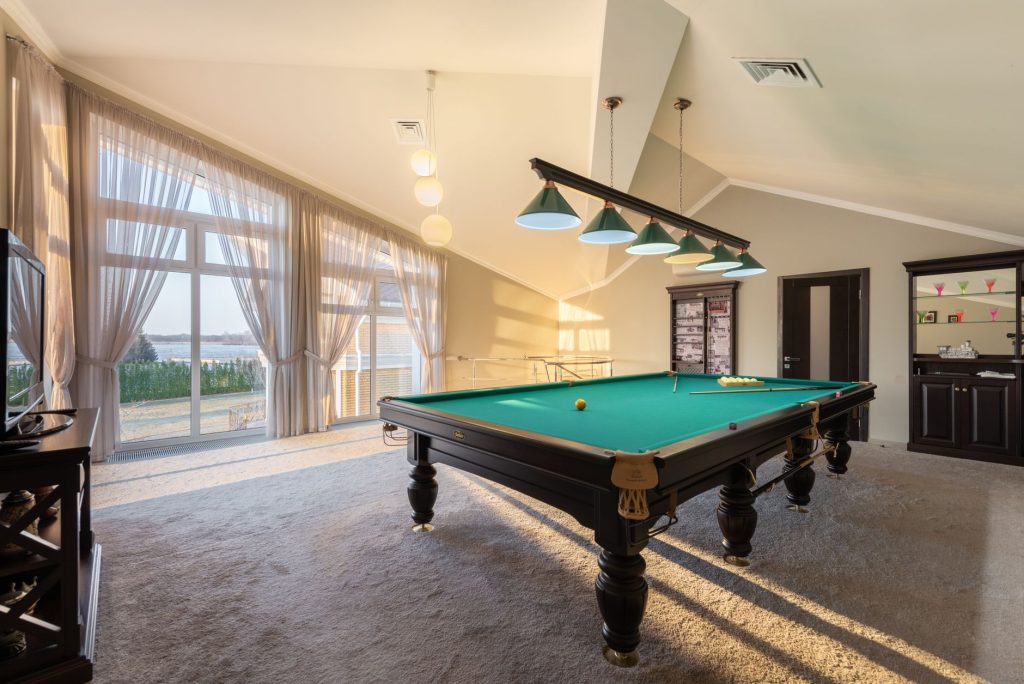
- Overhead light: Sized to the table, typically hung with the shade bottom a good distance above the cloth so it lights the whole bed without glaring in players’ eyes. Most lighting manufacturers suggest hanging height ranges on the box, so check that against your own ceiling height first.
- Cue rack: Wall-mounted racks save floor space in smaller game rooms; freestanding racks suit larger rooms with room to spare.
A reasonable starting kit (balls, cues, chalk, brush, cover) can be sourced as a bundle or built piece by piece. If you want to compare a few chalk, brush and cover bundles side by side, browse pool table accessory kits on Amazon to see current options and price ranges.
A Simple Sizing Walkthrough Before You Buy
Instead of buying accessories by brand reputation alone, run through this short check first:
- Measure your table’s playing surface and pocket opening width. Compare these against the spec sheet of any ball set or cloth product before ordering.
- Measure room clearance on all four sides, aiming for roughly 5 feet where possible, and note any pinch points like doorways or support posts that might favour shorter cues.
- Check your existing cloth type (worsted or napped) against any brush, cleaner, or conditioner you are considering.
- Measure ceiling height and compare it to the light fixture’s recommended hanging range, adjusting for a riser or shorter chain if your ceiling is lower than average.
This sequence takes a few minutes and prevents the single most common accessory mistake: buying something that is close enough rather than something that actually fits.
Common Mistakes When Buying Pool Table Accessories
- Buying balls before checking pocket size. A set that is slightly oversized for your pockets will constantly hang up on the rim.
- Choosing a light by looks rather than table width. A fixture sized for a 7 foot table often leaves the ends of a larger table dim.
- Using the wrong brush for the cloth. Stiff brushes on fine worsted cloth can wear the nap faster than normal play would.
- Skipping a cover. Dust and UV exposure are slow but steady causes of cloth fading and fibre breakdown over time.
- Ignoring room clearance when picking cue length. A full-length cue in a tight room forces awkward, jabbed shots rather than a clean stroke.
FAQ
What accessories do I actually need for a new pool table?
At minimum, a properly sized ball set, two or more cues, chalk, a triangle rack, and a cloth brush. A cover and overhead light are strongly recommended but can be added shortly after the table itself.
Will any pool cue work on any table?
Cue length is fairly standardised, but usability depends on your room’s clearance rather than the table itself. Check the walkthrough above and consider a shorter cue if your space is tight.
How do I know what size balls my table needs?
Measure your pockets and compare against the ball diameter listed on the product page. Compact and mini tables often use a smaller ball size than full regulation tables, so do not assume a standard set will fit.
How often should I replace cloth-care accessories like brushes?
There is no fixed schedule, but most players replace a brush once bristles noticeably soften or splay, which dulls its cleaning effect on the nap.
Final Recommendation
Start with the accessories that touch play directly, balls, cues, chalk, and a rack, confirmed against your table’s actual pocket size and cloth type. Add a cover and a correctly sized light once the basics are sorted, and use the clearance check above before committing to cue length or rack placement. If you are still finalising table size or room layout, it is worth reading our basement pool table buying guide first, since the table’s footprint drives nearly every accessory decision that follows. For a well-rated light fixture to compare specs against your own ceiling height, you can check current pool table light options on Amazon, and for cue storage, it is worth looking at wall-mounted cue rack listings on Amazon to see sizes that suit smaller game rooms.