
Man Cave Buyers Guide is a participant in the Amazon Services LLC Associates Program. If you buy through links on this page we may earn a commission, at no extra cost to you. We do not accept manufacturer samples or payment for favorable coverage.
A home theater recliner is one of the few purchases that shapes how much you actually use the room you built around it. Get the size, layout and mechanism wrong and even a great projector and screen will feel like an afterthought. Get it right and the recliner disappears into the experience, which is exactly the point.
Quick answer: Pick a home theater recliner based on row depth and doorway clearance first, then decide between manual and power reclining, then choose faux leather or fabric based on climate and maintenance tolerance. Measure before you shop, since most fit problems come from skipping this step.
How to Choose a Home Theater Recliner
Most buyers start with style and colour, which is understandable but backwards. Start with the room instead. A home theater recliner that looks perfect online can still leave you short on legroom, block a doorway when reclined, or crowd a screen that needs proper viewing distance. If you have not settled on your display yet, it is worth reading our Short Throw Projector Buying Guide for Man Caves alongside this one, since projector throw distance and seating depth are closely linked.
Work Out Your Row Depth First
This is the sizing step most listicles skip, and it is the one that actually prevents returns. Manufacturers typically spec a reclined depth for their chairs, often somewhere in the range of 60 to 70 inches from wall to fully extended footrest, but always check the spec sheet for the specific model rather than assuming. To work out your own row depth:
- Measure from the wall behind the seat to the nearest obstruction in front, such as a screen, riser edge or walkway.
- Subtract roughly 6 to 10 inches as a buffer so the recliner is not fighting for space at full extension.
- Compare what is left against the reclined depth listed on the product page, and lean toward the shorter side of any range if you are unsure.
- If you are building on a riser, plan for it to eat into headroom as well as depth, commonly around 8 to 12 inches, so measure your actual ceiling height before assuming a riser will work.
If your room is tight, look specifically for wall-hugger or wall-away designs, which recline by sliding the seat forward rather than pushing the back into the wall. These can cut required clearance dramatically, though the exact figure varies by brand, so confirm it on the listing rather than assuming a universal number.
Seat Width and Row Count
As a rule of thumb, plan for roughly 3.5 to 4 feet of total width per seat once you include a console or armrest, though this varies by chair and by how tight you are willing to sit. If you are building a genuine multi-row setup, our Man Cave Basement Decor Guide covers room-by-room layout planning that pairs well with the seating math here.
Manual vs Power Recline
Manual recliners cost less, have fewer parts to fail, and work fine if the room never loses power. Power recliners are more common in dedicated theater seating because they allow smoother, quieter adjustment and often include memory positions, USB charging or lumbar adjustment. The tradeoff is a power cord to route, a motor that can eventually wear out, and typically a higher price point. If you want a genuine theater feel and do not mind occasional maintenance, power is usually worth it. If you want something that will still work in ten years with zero fuss, manual is the safer long-term bet.
Home Theater Recliner Types Compared
- Standard recliner: Best value, works in almost any room, needs the most wall clearance when reclined.
- Wall-hugger recliner: Slightly higher cost, ideal for tight basements or rooms with limited depth behind the seat.
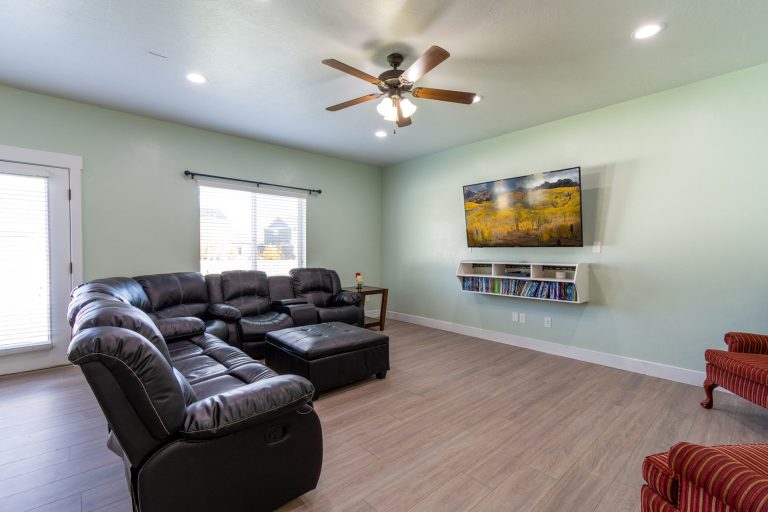
- Power recliner with console: Best for multi-seat rows, adds cupholders and storage, higher price and needs power access.
- Rocker recliner: More casual movement, less common in dedicated theater rooms, better suited to general lounge use.
- Big and tall recliner: Reinforced frame and wider seat, worth checking weight capacity and seat width specs directly against your needs.
For most home theater builds, a power recliner with a console strikes the best balance of comfort and function, provided the room has the depth and power access to support it. You can browse current options here: home theater power recliners on Amazon.
Common Mistakes to Avoid
- Skipping the reclined-depth check. Upright dimensions look fine on paper, then the footrest hits a wall or riser edge.
- Ignoring the screen relationship. Seating too close to a large screen causes eye strain, and matte versus ambient-light-rejecting screens change the ideal distance. Our ALR Screen Buying Guide explains how screen type affects viewing angle and distance.
- Choosing fabric or leather without thinking about the room. Basements with humidity swings tend to favour faux leather, which wipes clean and resists moisture better than fabric in most cases.
- Buying a set based on width alone. Depth, arm height and headrest position affect comfort as much as width does.
- Assuming every power recliner ships with the same cord length or outlet placement. Check this before finalising your electrical plan.
FAQ
How much space do you need behind a home theater recliner?
As a starting point, plan for roughly 6 to 10 inches of clearance beyond the manufacturer’s reclined depth spec, then confirm against your own room measurement before buying.
Are power recliners worth it for a home theater?
For a dedicated theater room used regularly, power recliners generally offer a smoother experience and useful features like memory positions, though manual models remain a reliable lower-maintenance option.
What is the difference between a wall-hugger and a standard recliner?
A wall-hugger slides forward as it reclines rather than tilting back into the wall, which typically reduces the clearance needed behind the chair, useful in basements or rooms with limited depth.
How many home theater recliners fit in a small room?
It depends on your row width and depth math above, but as a rough guide, most small dedicated theater rooms comfortably fit two to three recliners per row once console width is included.
Final Recommendation
Measure your room before you shop, decide on manual versus power based on how you will actually use the space, and choose material based on your room’s climate rather than looks alone. If you want to start comparing options with these factors in mind, this is a solid place to browse: home theater recliners on Amazon, or for multi-seat setups, theater recliner sets with consoles.