Man Cave Buyers Guide is a participant in the Amazon Services LLC Associates Program. If you buy through links on this page we may earn a commission, at no extra cost to you. We do not accept manufacturer samples or payment for favorable coverage.
If you’re hanging a board in the garage or settling a dispute mid-game, dartboard rules matter more than people expect. Get the height or distance wrong and every 501 leg you play is technically off, even if nobody notices until a guest who plays in a league shows up and asks why the oche looks short.
Quick answer: Official dartboard rules place the bullseye about 5 feet 8 inches off the floor and the oche roughly 7 feet 9.25 inches away for steel-tip boards, with soft-tip distances often slightly longer. Standard games are 501, 301, and Cricket. Always double-check your board’s spec sheet before marking a permanent line.
Dartboard Rules for Height, Distance and Layout
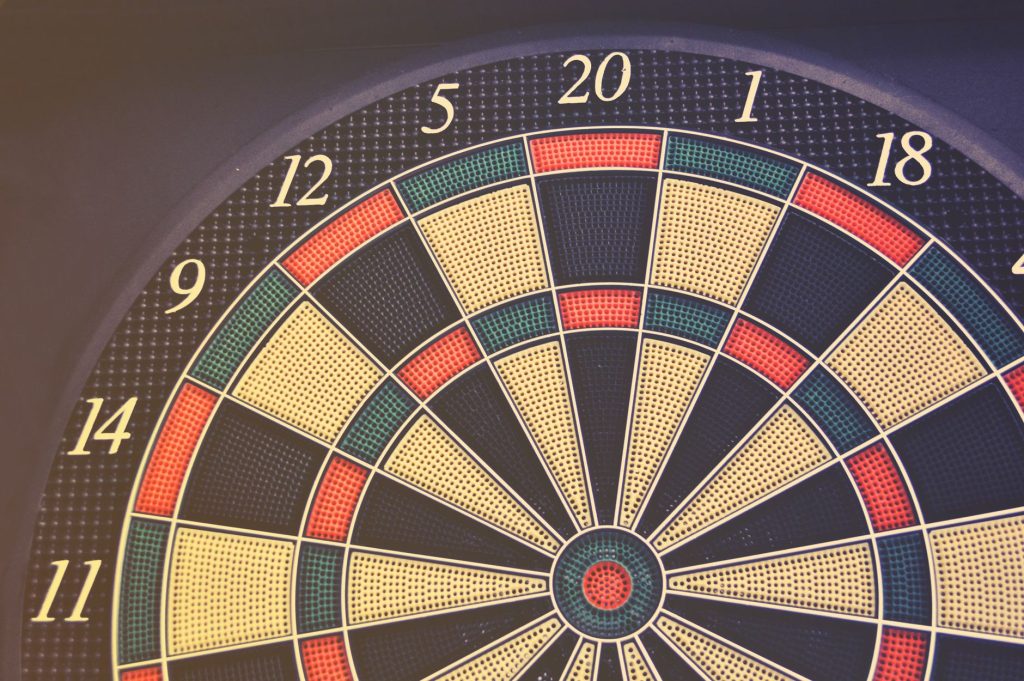
The two numbers that get quoted most often in dartboard rules are bullseye height and oche distance, and both come from the World Darts Federation’s steel-tip standard. As a rule of thumb, manufacturers spec the bullseye centre at roughly 5 feet 8 inches (about 173 cm) from the floor, and the throw line at approximately 7 feet 9.25 inches horizontal distance from the board’s face. That horizontal distance, not the diagonal line from board to oche, is the figure that actually matters, so measure it with a tape along the floor rather than eyeballing a diagonal.
Soft-tip electronic boards commonly use a slightly longer throwing distance, often cited around 8 feet, but this varies by manufacturer and league, so check the instructions that came with your board before you commit to a permanent mark on the floor. If you’re still choosing a board and backboard combination, our Dartboard Backboard Buying Guide: Sizing & Fit walks through how much wall space and surround clearance you actually need once these regulation distances are factored in.
Clearance and Surround Space
Beyond height and distance, dartboard rules assume a reasonable buffer zone around the board so stray darts don’t do damage and players have room to throw comfortably. Plan for roughly 3 feet of clear space on either side of the board and enough depth behind the oche for a full arm swing, then confirm against your own room before you drill a single hole. If you’re mounting inside a cabinet, our Dartboard and Cabinet Buying Guide covers how door swing and cabinet depth interact with that clearance, which is easy to overlook until the doors won’t open past a thrown dart.
Standard Dartboard Game Rules
Once the board is hung correctly, the next layer of dartboard rules covers how the games themselves are actually played. Most home setups rotate between a handful of formats, and knowing the basics prevents the classic argument about whether a double is required to finish.
501 and 301 Rules
These are the most common scoring games. Each player starts at 501 or 301 points and subtracts their throw total each turn, aiming to reach exactly zero. The catch that trips up newer players is the finish: most formats require the final dart to land in a double segment or the bullseye, so a player sitting on an odd remaining score like 1 technically cannot finish and has to work the count back down to an even number first.
Cricket Rules
Cricket uses only the numbers 15 through 20 plus the bullseye. Each number needs three hits to be closed, after which a player can score against opponents who haven’t closed it yet. It rewards accuracy over raw scoring speed and tends to suit smaller groups or shorter sessions since a round rarely drags on as long as a 501 leg can.
Around the Clock and Casual Variants
For beginners or mixed-skill groups, Around the Clock (hitting numbers 1 through 20 in order) is a common house favourite because it teaches aim without the pressure of finishing on a double. These casual formats sit outside official dartboard rules but are worth keeping in your back pocket for family game nights.
A Quick Framework: Official Rules vs House Rules
Not every home game needs tournament-grade precision, and deciding which rules apply saves arguments later. Ask three questions before you set up:
- Is anyone scoring for a league or ranking? If yes, stick to official height, distance and finish-on-double rules exactly.
- Are kids or first-timers playing? Shortening the oche distance slightly or dropping the double-out requirement is a reasonable house adjustment, as long as everyone agrees before the first throw.
- Is the room a genuine constraint? If your space can’t fit full regulation distance, a slightly shorter oche is better than a cramped, unsafe throwing lane. Just be consistent about it and don’t switch mid-game.
Setup Checklist: Getting Your Board Regulation-Ready
- Confirm bullseye height at roughly 5 feet 8 inches, measured with a level rather than by eye.
- Measure oche distance horizontally along the floor, not diagonally to the board face.
- Check your specific board type (steel-tip vs soft-tip) against its own spec sheet, since distances differ.
- Leave clear space either side of the board and behind the throw line for a full arm swing.
- Mark the oche with tape or a purpose-made throw line marker rather than trusting memory once the room fills with guests.
- Agree house rule exceptions before play starts, not halfway through a leg.
Common Mistakes When Setting Up by Dartboard Rules
- Measuring the diagonal instead of the horizontal distance. This quietly shortens the actual throw and skews scoring difficulty.
- Guessing bullseye height instead of using a tape measure. A couple of inches off changes the angle of every throw more than people expect.
- Ignoring backboard and cabinet clearance. A board mounted too close to a doorway or light fixture invites damage regardless of how correct the oche distance is.
- Mixing rule sets mid-game. Switching between double-out and straight-out finishes partway through a match is the fastest way to start a friendly argument.
- Assuming soft-tip and steel-tip distances are identical. They commonly aren’t, so check before you tape the floor.
FAQ
What is the official height for a dartboard?
Most manufacturers and league bodies spec the bullseye centre at roughly 5 feet 8 inches from the floor. Confirm against your specific board’s instructions, since minor variations exist between organisations.
How far should the oche be from the dartboard?
For steel-tip boards, expect approximately 7 feet 9.25 inches measured horizontally from the board’s face to the throw line. Soft-tip setups are often slightly longer, so check your board’s spec sheet before marking the floor.
Do you have to finish on a double in darts?
In standard 501 and 301 rules, yes, the winning dart typically must land in a double segment or the bullseye. Casual house games sometimes drop this requirement, which is fine as long as everyone agrees beforehand.
What happens if a dart bounces out or falls off the board?
A dart that bounces off or fails to stick generally scores nothing and isn’t rethrown, under most standard rule sets. It still counts as one of the three darts for that turn.
Final Recommendation
Getting dartboard rules right is less about memorising every league regulation and more about being consistent: measure height and distance properly once, agree on scoring format before the first throw, and adjust deliberately for casual play rather than by accident. If you’re still finalising the board itself or how it’s mounted, our Dartboard and Cabinet Buying Guide is a solid next stop for matching hardware to the room you actually have.