Man Cave Buyers Guide is a participant in the Amazon Services LLC Associates Program. If you buy through links on this page we may earn a commission, at no extra cost to you. We do not accept manufacturer samples or payment for favorable coverage.
A dartboard and cabinet combo is one of the easiest wins for a game room or man cave, but the wrong choice leads to a board that warps, a cabinet that swings into a light fixture, or darts bouncing off a wall that never gets patched properly. Getting the fit right matters more than the brand name on the box.
Quick answer: For most home setups, a bristle dartboard in a lockable wood cabinet with a chalk scoreboard and enclosed dart storage gives the best mix of durability and looks. Measure a 9 to 10 foot clear zone in front of the wall before buying, and check the cabinet depth matches your wall space.
What to Check Before Buying a Dartboard and Cabinet Set
Most dartboard and cabinet sets are sold together, which is convenient but can hide compatibility issues. Before you add one to your cart, work through this short checklist.
- Board type inside the cabinet: confirm whether it ships with a bristle board, an electronic board, or an empty slot for you to fit your own.
- Cabinet door swing: doors typically open outward by 12 to 18 inches. Check nothing behind them, like a shelf or door frame, will get in the way.
- Mounting hardware included: some cabinets come with cleats and screws, others assume you already own basic wall anchors.
- Wall type at the hanging spot: drywall over studs is fine with the right anchors, but plaster or concrete needs different fixings entirely.
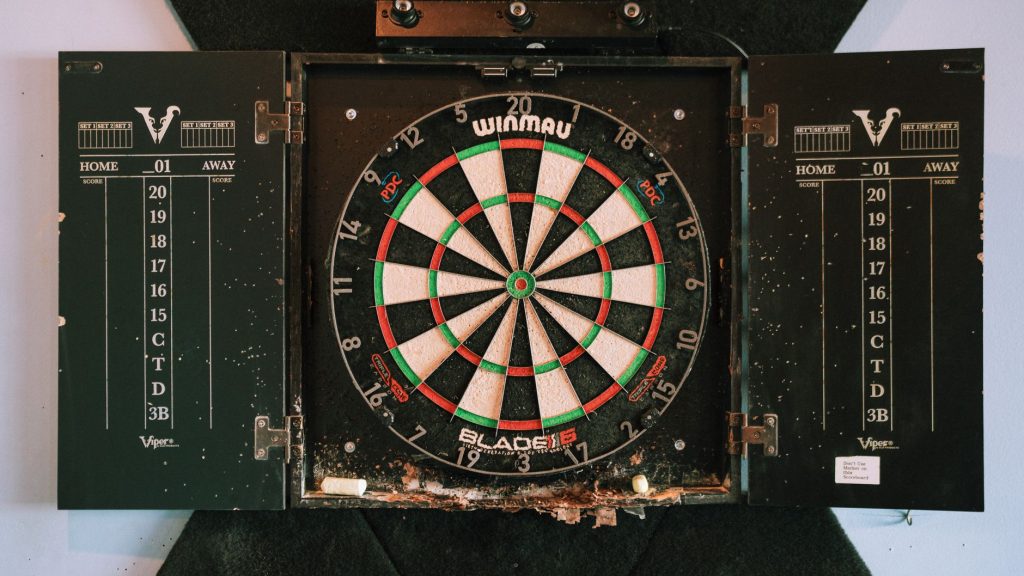
- Storage compartments: look for a proper dart holder and a chalkboard or scoreboard built into the doors, since these are the features owners miss most when absent.
Bristle vs Electronic Dartboards in a Cabinet
Bristle Boards
Bristle (sisal) boards are the standard for steel-tip darts. They self-heal around the fibres, last for years with occasional rotation, and give the quieter, more traditional feel most home bars go for. They need a proper backing wall or cabinet surround since steel tips will damage drywall on a miss.
Electronic Boards
Electronic boards use soft-tip darts and plastic segments, with built-in scoring and game modes. They are a good fit for households with kids or anyone who wants automatic scoring without chalk. The tradeoff is that plastic segments wear out faster than bristle and the electronics need power nearby, which some cabinets are not wired to accommodate.
If you are undecided, a cabinet built for a bristle board is usually the safer long-term buy, since bristle boards outlast the segmented style by a wide margin under regular play.
Cabinet Features That Actually Matter
Not every cabinet feature is worth paying extra for. Focus on these:
- Solid wood or veneer over MDF: both work fine for a dry indoor room, but solid wood holds up better if the cabinet gets bumped often.
- Lockable doors: useful if darts are stored inside and there are younger kids in the house.
- Built-in scoreboard: chalk or dry-erase boards on the inside of the doors save you buying a separate one.
- Finish that matches your room: a cabinet finished in a dark walnut or black oak tends to blend into most home bar setups better than a plain pine box.
If you are still finalising the wider room layout, our guide on man cave wall decor ideas covers how to balance a dartboard cabinet against shelving, signage and lighting so the wall does not feel cluttered.
Sizing Your Wall Space Correctly
This is the step most buyers skip, and it is the reason so many boards end up mounted in the wrong spot. Work through it in this order:
- Standard dartboard height is 5 feet 8 inches from the floor to the centre bullseye. Mark that point on the wall first.
- Standard oche (throwing line) distance is 7 feet 9.25 inches from the face of the board for steel-tip play, slightly different for soft-tip. Measure out from your marked centre point.
- Add at least a foot of buffer beyond the oche line for backswing room, and another foot to either side for the cabinet doors and anyone walking past.
- In total, aim for roughly 9 to 10 feet of clear depth and about 4 feet of width free of furniture, doors or light switches.
If your basement or games room is tight on space, it is worth reading our basement game room bar ideas guide before committing to a wall, since dartboard placement often has to work around bar seating and traffic flow rather than the other way round.
Common Mistakes Buyers Make
- Mounting the board without checking backswing clearance, then finding darts clip a nearby shelf or lamp.
- Buying a cabinet with a bristle board included but steel-tip darts that are too heavy or long for the board’s segment width.
- Ignoring the wall material and using drywall anchors rated for far less weight than a full cabinet with doors and darts.
- Skipping a check on room lighting, which leaves the board too dim to score accurately at night. A wall-mounted light on an adjustable arm solves this cheaply.
For a ready-made bristle dartboard and cabinet set, it helps to compare a few options side by side rather than buying the first one that appears in search results. You can browse current listings here: dartboard and cabinet sets on Amazon.
FAQ
What size cabinet do I need for a standard dartboard?
Most dartboard cabinets are built around an 18 inch board, so the cabinet itself typically measures somewhere in the 24 to 30 inch range once you include door hinges and side clearance. Always check the listed exterior dimensions rather than assuming from the board size alone.
Can I fit my own dartboard into a cabinet that came without one?
In most cases yes, provided the internal recess matches the standard 18 inch board diameter. Measure the cabinet’s inner frame before buying a separate board, since a handful of cabinets are built for slightly oversized or novelty boards.
Do I need a backboard or surround if I already have a cabinet?
No, a proper cabinet already acts as the surround and protects the wall from stray darts. If you are mounting a board without a cabinet, a separate backboard is worth adding.
How much clearance do I need in a small room?
Aim for the full 9 to 10 foot depth if possible. If your room genuinely cannot fit that, a soft-tip electronic board with shorter recommended throwing distances is a more realistic option than squeezing a steel-tip setup into a cramped space.
Final Recommendation
For most buyers, a bristle dartboard and cabinet combo with a lockable door and built-in scoreboard offers the best long-term value, provided you measure your wall space properly before ordering. If your room is genuinely short on depth, lean towards an electronic soft-tip board instead of forcing a steel-tip setup into a space that cannot safely fit it. Once the board is sorted, it is worth checking our bar top materials guide if you are finishing the rest of the room at the same time, and you can compare current cabinet options directly here: bristle dartboard cabinets on Amazon.