Man Cave Buyers Guide is a participant in the Amazon Services LLC Associates Program. If you buy through links on this page we may earn a commission, at no extra cost to you. We do not accept manufacturer samples or payment for favorable coverage.
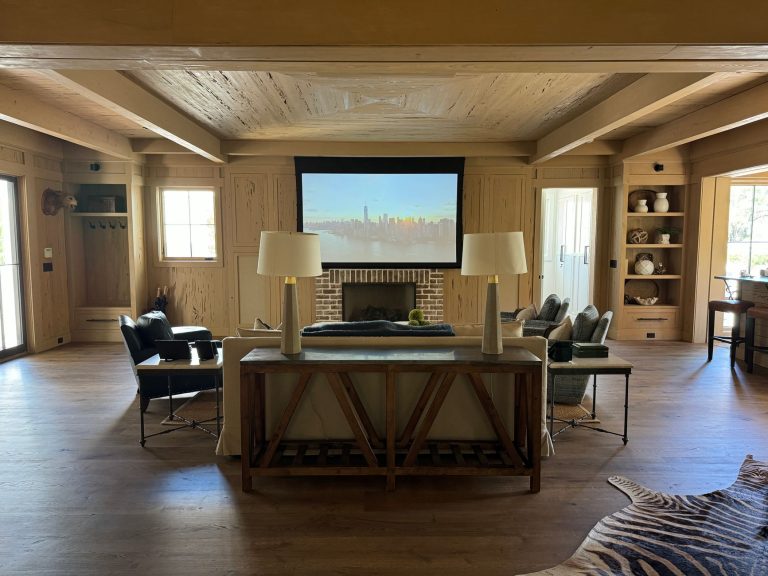
A retractable projector screen is the fix for anyone who wants a proper big-screen picture without giving up the wall or ceiling for good. It disappears when you’re not watching, which matters a lot in a multi-purpose room like a den, garage bar or basement game room. But not every retractable screen suits every setup, and the wrong choice can leave you with clearance problems, motor noise, or a picture that fights the ambient light in the room.
Quick answer: Pick a motorized ceiling recessed screen if you have at least 6 to 8 inches of true ceiling clearance and want a clean look; pick a wall mounted or floor rising screen if you don’t. Manual pull down screens save money but sag and slow-drop issues get worse over time, so budget motorized whenever the room allows it.
How a Retractable Projector Screen Actually Works
Every retractable projector screen shares the same basic idea: the screen material rolls onto a tube housed in a case, and a spring, ratchet or motor controls the drop and retraction. Where they differ is mounting position and how that drop is powered.
Ceiling Recessed vs Ceiling Mounted vs Wall Mounted
A ceiling recessed screen sits inside the ceiling itself, with only a thin trim visible when it’s closed. It looks the cleanest but demands the most planning, since the case has to fit above the drywall or drop ceiling before the room is finished. A surface-mounted ceiling screen bolts to the underside of the ceiling instead, which is far easier to retrofit into a finished room but leaves a visible case hanging down. Wall mounted retractable screens sit above or beside the viewing area and work well when ceiling access is limited or you’re renting.
Manual vs Motorized
Manual pull down screens use a spring-loaded roller, similar to an old window blind. They’re the cheapest option and have no wiring to run, but the drop mechanism is the first thing to wear out, and getting an even, wrinkle-free drop gets harder as the springs age. Motorized screens use an electric tube motor triggered by a remote, wall switch, or a 12V trigger from the projector. They cost more up front and need a power run to the case, but they give a smoother, more repeatable drop and are the better match for anyone pairing the screen with a ceiling-mounted projector on a schedule. If you’re mounting a projector at the same time, our Ceiling Mount Projector Bracket Buying Guide is worth reading before you finalize the screen position, since throw distance and screen height need to agree with each other.
Sizing and Clearance: A Buyer’s Walkthrough
Retractable screen sizing goes wrong more often from clearance mistakes than from picking the wrong diagonal. Work through it in this order:
- Case clearance: Manufacturers commonly spec a case that runs a few inches longer than the screen’s viewing width, so measure your wall or ceiling span with that margin included, not just the diagonal size.
- Drop clearance: Plan for the case itself to eat roughly 4 to 8 inches of vertical space before the screen material even starts to drop, and check the spec sheet for your specific model rather than assuming.
- Black drop and top border: Most motorized screens include a black leader strip above the image area so the case doesn’t intrude on the picture. As a rule of thumb, budget an extra 12 to 18 inches of total drop beyond the visible image height, then confirm against the product’s own drawing.
- Projector throw distance: Screen width and projector placement have to be solved together. If you’re leaning toward a short throw model to keep the setup compact, see our Short Throw Projector Buying Guide for Man Caves before you lock in a screen width.
- Seating distance: A common starting rule is that screen height times roughly 1.5 to 2 gives a comfortable viewing distance for most home theater content, though personal preference and content type shift that range.
If you’re still shopping for the screen itself, a search like this shows the current range of motorized options across sizes: motorized retractable projector screens on Amazon.
Screen Material and Ambient Light
The retraction mechanism only solves storage. The material solves picture quality, and that’s where a lot of buyers get caught out. A basic white matte surface works fine in a room you can darken properly. If your man cave has windows, a bar area with ambient lighting, or a walkout basement that never gets fully black, a standard retractable screen will look washed out no matter how good the projector is. In that case, look at an ambient light rejecting (ALR) surface, which is engineered to bounce room light away from the viewer while still reflecting the projector’s image. Our ALR Screen Buying Guide walks through which ALR types suit which lighting conditions, and if you’re dealing with a basement specifically, the Basement Projector Setup guide covers the room-level fixes that go alongside screen choice.
Retractable Screen Comparison Checklist
- Confirm true ceiling or wall clearance including the case, not just the image area
- Decide manual vs motorized based on budget and how often the screen will be used daily
- Match screen width to your projector’s throw distance before buying either
- Check whether the screen surface handles your room’s ambient light or needs an ALR upgrade
- Check the control options: remote, wall switch, or 12V trigger synced to the projector
- Look at warranty length on the motor specifically, since that’s the part most likely to need service
Common Mistakes Buyers Make
The most frequent error is measuring the visible screen size and forgetting the case and black drop, which leaves the image sitting lower or higher than planned once installed. A close second is buying a motorized screen without checking whether the case will accept a 12V trigger cable from the projector, forcing an extra remote into the routine. Buyers in bright rooms also tend to buy a standard matte screen because it’s cheaper, then get frustrated with a dim, low-contrast picture that no projector setting can fully correct. Finally, wall mounted screens are sometimes installed too close to the projector’s lens axis, causing keystoning that a flat screen can’t fix on its own.
FAQ
Are retractable projector screens worth it over a fixed frame screen?
If the room doubles as a living space, game room or bar, yes, since a fixed frame screen occupies wall space permanently. If the room is dedicated solely to viewing, a fixed frame screen is usually flatter and slightly better optically, so the tradeoff comes down to how multi-purpose the room needs to be.
Motorized or manual, which should I buy?
Motorized suits daily or semi-daily use and pairs cleanly with a ceiling-mounted projector on a remote or automation system. Manual suits occasional use and tighter budgets, but expect the drop mechanism to wear faster with frequent use.
What size retractable screen fits my room?
Start from your seating distance and work backward using the height times 1.5 to 2 guideline, then check that a screen of that width still leaves the case clearance your ceiling or wall can actually provide.
Do retractable screens work in a room with windows or open lighting?
A standard matte surface will struggle. An ALR retractable screen or added light control in the room (blackout shades, redirected fixtures) makes a much bigger difference than projector brightness alone.
Bottom Line
Buy a motorized ceiling recessed screen if your ceiling has the clearance and you want the cleanest finished look. Choose a surface-mounted or wall mounted motorized unit if you’re retrofitting a finished room. Only drop to a manual screen if budget is the deciding factor, and treat ambient light in the room as a material decision, not just a projector brightness problem. If you’re ready to compare current options by size and control type, this search is a reasonable starting point: electric projector screens, 100 inch and up, on Amazon, and if budget is tight this search covers manual pull down alternatives: manual pull down projector screens on Amazon.