Man Cave Buyers Guide is a participant in the Amazon Services LLC Associates Program. If you buy through links on this page we may earn a commission, at no extra cost to you. We do not accept manufacturer samples or payment for favorable coverage.
Tight basement rooms, low ceilings and couches jammed close to the wall are exactly why a short throw projector exists. Instead of needing 10 to 15 feet of clearance to fill a screen, these units sit close to the wall and still throw a large, usable image, which makes them a genuinely good fit for game rooms and home theaters built into awkward spaces.
Quick answer: A short throw projector is the right call when your mounting distance is roughly 3 to 8 feet from the screen. Look at throw ratio first, brightness second, and match both to your room’s ambient light before worrying about resolution or smart features.
What Makes Something a Short Throw Projector
The number that actually defines a short throw projector is the throw ratio, not the marketing name on the box. Throw ratio is the distance from the lens to the screen divided by the width of the image it produces. A standard projector often sits around 1.5:1 to 2:1, meaning it needs one and a half to two feet of distance for every foot of image width. A short throw model typically runs 0.4:1 to 1:1, so it produces a much bigger image from much less distance.
Ultra short throw (UST) projectors push this further, often below 0.4:1, and can sit inches from the wall while still filling a 100 inch or larger screen. That is the category getting most of the attention right now because it lets you build a proper home theater look in a room that never had the depth for a traditional setup.
Short Throw vs Ultra Short Throw
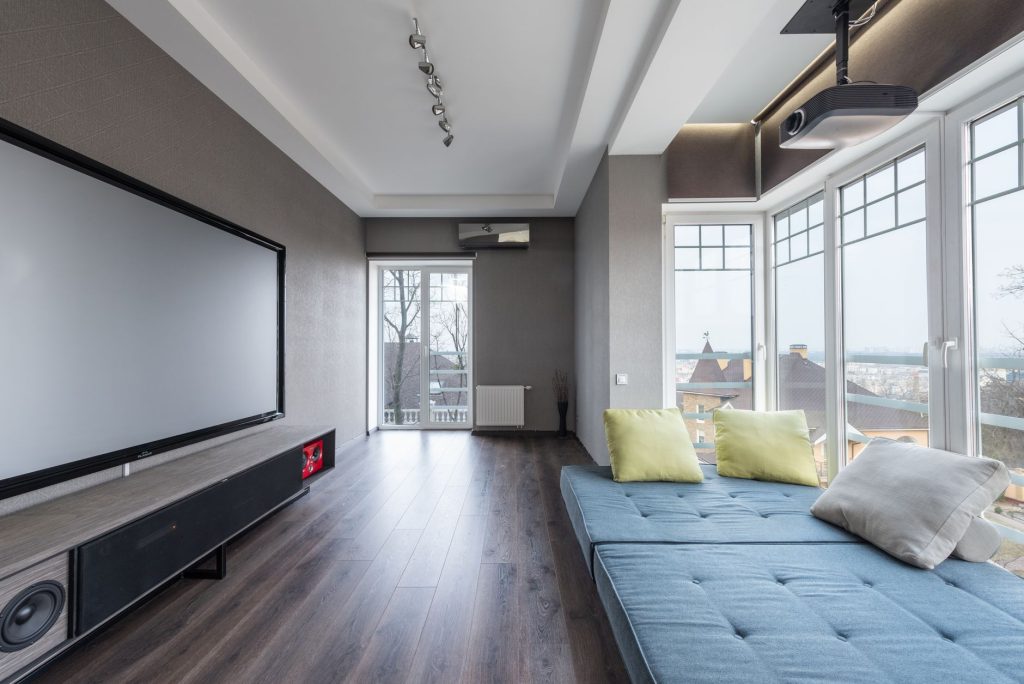
Short throw and ultra short throw solve the same problem at different intensities. A short throw unit still needs a small media console or shelf a few feet back from the wall, which suits basements and game rooms with some floor depth to spare. An ultra short throw unit sits almost flush against the wall, which matters if you are trying to keep a bar cart, dartboard cabinet or seating area close to that same wall without a projector body in the way.
If you are undecided, measure your actual available distance before you shop. It removes half the guesswork immediately.
A Sizing Walkthrough Before You Buy
This is the part most buying guides skip, and it is the one that actually prevents returns.
- Measure your real throw distance. Stand where the projector will sit (shelf, console or ceiling mount point) and measure to the wall or screen in feet.
- Check the throw ratio range on the spec sheet. Multiply your distance by the ratio to estimate the image width you will get. A 6 foot distance with a 0.5:1 ratio gives roughly a 12 foot wide image, which is far larger than most rooms need.
- Work backwards from screen size instead if you already own a screen. Divide your intended image width by the throw ratio to find the distance the projector needs to sit at.
- Leave a margin of error. Manufacturers list a ratio range, not a fixed number, so confirm you are comfortably inside it rather than right at the edge.
Once distance is settled, brightness is the next filter. Lumens matter less than how much control you have over ambient light in the room. A projector rated for a fully dark theatre room can look washed out in a basement with a window or a bar area with overhead lighting. If your room cannot be fully blacked out, read our basement projector ambient light setup guide before picking a brightness spec, since pairing the right screen material with the projector often matters more than chasing a higher lumen number.
If you want to start comparing current models by throw distance and brightness rating side by side, this is a reasonable place to begin: short throw projectors on Amazon.
Screen Pairing Matters More Than People Expect
Ultra short throw projectors in particular are sensitive to screen surface. Because the light hits the screen at a steep angle from below rather than straight on, a standard matte white screen can produce hot spots or uneven brightness. Ambient light rejecting (ALR) screens designed specifically for UST throw angles solve this and are worth the extra cost if you are running one of these units in a room with any daylight or lamps nearby.
Browse ALR screens built for ultra short throw projectors if your room will never be fully dark, and pair that with the layout advice in our basement decor guide when planning where the screen wall and seating will sit relative to windows or bar lighting.
Checklist Before You Add One to Cart
- Confirmed throw distance measured in your actual room, not estimated
- Throw ratio on the spec sheet covers that distance comfortably
- Brightness rating matches how dark the room gets, honestly assessed
- Screen size fits the wall without crowding doorways or furniture
- Input options cover your consoles, streaming box and any cable box
- Mounting or shelf placement keeps the lens free of shadows from people walking past
Common Mistakes
The most frequent issue is buying based on resolution and smart features while ignoring throw ratio entirely, then discovering the image is either too small for the wall or too large to fit without cropping. The second most common mistake is assuming a projector rated for a dark theatre will perform the same in a room with a window or bar lighting nearby, then blaming the projector for a washed out picture that is really an ambient light and screen mismatch. The third is mounting or shelving the unit somewhere that gets walked past, which throws a shadow across the image at the worst possible moment.
FAQ
Is a short throw projector worth it for a basement game room?
Yes, if your room depth is limited. It lets you get a large image without needing 12 to 15 feet of clearance, which most basements simply do not have once seating and a bar area are factored in.
How close can a short throw projector actually be to the wall?
Standard short throw units usually need a few feet of distance, while ultra short throw units can sit within inches of the wall. Always check the specific throw ratio rather than assuming based on the category name.
Do short throw projectors need a special screen?
Not always, but ultra short throw units benefit significantly from an ALR screen designed for steep projection angles, especially in rooms that are not fully dark.
Can I mount a short throw projector on the ceiling instead of a shelf?
Some models support this, but ceiling mounting changes the throw distance and angle calculations, so confirm the manufacturer’s mounting guidance before drilling anything.
Bottom Line
Sort by throw ratio and honest room brightness before anything else, and a short throw projector will earn its keep in almost any man cave layout, including the tight basement setups where a traditional projector was never going to work.