
Man Cave Buyers Guide is a participant in the Amazon Services LLC Associates Program. If you buy through links on this page we may earn a commission, at no extra cost to you. We do not accept manufacturer samples or payment for favorable coverage.
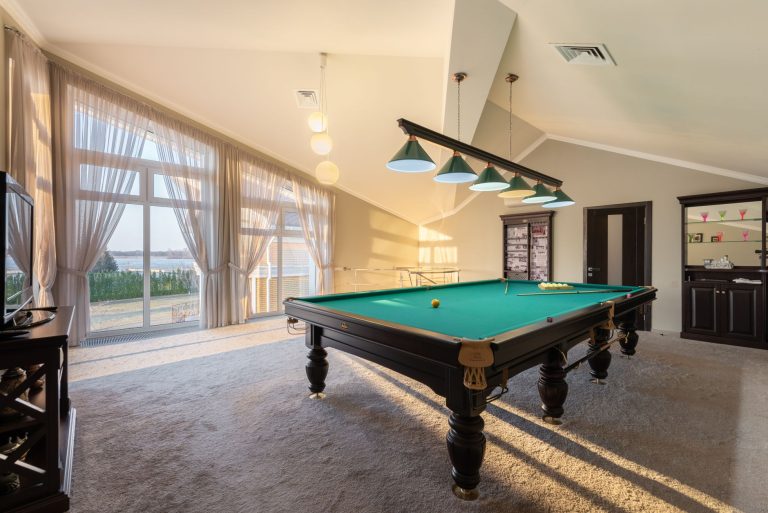
An 8 foot pool table sits right in the middle of the sizing chart, which is exactly why so many home buyers land on it. It is smaller than the 9 foot tables you see in tournament halls, but roomier and truer-playing than a compact 7 foot bar table. The catch is that “8 foot” describes the playing surface, not the space you need around it, and that gap trips up more buyers than any other spec on the sheet.
Quick answer: An 8 foot pool table (playing surface roughly 92 x 46 inches, check the maker’s spec sheet) needs a room commonly around 13 to 14 feet by 16 to 17 feet to allow a full cue stroke on every rail. If your room is tighter, measure cue clearance before you order.
What an 8 Foot Pool Table Actually Means
Pool tables are sized by the playing surface, the cloth-covered area inside the rails, not the overall footprint of the cabinet. Most manufacturers spec an 8 foot table’s playing surface at somewhere around 92 inches by 46 inches, though you should always confirm this against the individual product listing since rail and pocket styles shift the numbers slightly. Add the width of the rails and pockets and the actual cabinet footprint is typically a bit larger again, so treat the “8 foot” label as a starting point, not the number you plan your room around.
Playing Surface vs Room Footprint
The number that actually determines whether a table fits your space is not the table’s footprint at all, it is the cue clearance zone around it. A player needs room to draw a cue back and follow through on every side of the table, and that clearance is what most buyers underestimate.
Room Size Walkthrough for an 8 Foot Pool Table
This is the part generic spec sheets skip, so work through it before you shop rather than after the table arrives.
Step 1: Measure Wall to Wall
Measure the room’s clear width and length, wall to wall, ignoring furniture you plan to move. Note any fixed obstructions like support posts, staircases, or a fireplace hearth that eats into the clearance zone on one side only.
Step 2: Add Cue Length Clearance
As a rule of thumb, plan for roughly 5 feet of clear space beyond each rail to accommodate a standard cue and a full stroke. That means an 8 foot table with a playing surface near 92 x 46 inches commonly wants a room somewhere around 13 to 14 feet by 16 to 17 feet, but always cross-check this against your own cue length and the table’s actual footprint, since shorter house cues or a tighter house rule on stroke length can shrink the number a little.
Step 3: Check for Asymmetric Obstructions
A doorway, radiator, or low bookshelf on one side does not need the full clearance if players simply favour a shorter bridge on that rail, but a load-bearing post or low ceiling beam is a harder stop. Walk the room with a tape measure and mark the four corners of the likely table position with painter’s tape before you order anything.
If your basement or rec room is genuinely tight, it is worth reading a dedicated basement pool table buying guide before committing to a size, since low ceilings and support columns change the calculation in ways a generic room chart cannot.
8 Foot vs 7 Foot vs 9 Foot: Which Size Fits Your Room
- 7 foot table: The common choice for bars, apartments and smaller game rooms. Easiest to fit, but the shorter rails change shot angles noticeably if you are used to a bigger table.
- 8 foot table: The realistic sweet spot for most home game rooms. Close enough to tournament proportions that shots feel natural, while still fitting rooms that a 9 foot table would overwhelm.
- 9 foot table: The regulation size used in most competitive play. Fantastic if you have a dedicated games room with real square footage to spare, but it demands a large, mostly obstruction-free space.
If you are furnishing a multi-game room rather than a single-purpose one, it is worth planning the whole layout at once. Readers converting a garage or basement into a combined games space often pair this decision with a look at a standard shuffleboard table size guide or a poker table with dining top, since both share the same clearance-first logic as a pool table.
Slate, Cloth and Other Buying Considerations
Bed Material
Slate beds are the standard for genuine play quality and long-term flatness, and most serious 8 foot tables on the market use one, two or three-piece slate. Non-slate or particleboard beds cost less and are lighter to move, but expect them to be more prone to warping over years of use, particularly in rooms with humidity swings.
Cloth and Pocket Style
Worsted cloth plays faster and holds up better over time than a napped woollen cloth, though it typically costs more. Pocket style is largely aesthetic, but drop pockets are generally easier to service than moulded ones if a pocket ever needs replacing.
Cost of Ownership
Beyond the sticker price, budget for delivery and professional assembly, since a slate table is genuinely heavy and most installers recommend it is levelled by someone experienced. Recover the cloth every several years depending on how often the table sees play, and factor in a cue rack, balls and a decent set of cues if you are starting from nothing. A browse through current 8 foot slate pool table listings is a useful way to see how these features affect price before you commit to a specific model.
Common Mistakes to Avoid
- Measuring only the table’s footprint. The cabinet size tells you almost nothing about whether a real game can be played comfortably in the room.
- Forgetting ceiling height for a raised playing area. If the table sits on a platform or riser, plan for that to add height that a standard ceiling may not accommodate, and measure your own ceiling before you commit.
- Buying accessories as an afterthought. Cues, a triangle rack, chalk and a decent set of balls are easy to forget until the table arrives with nothing to play with. A basic pool cue and accessory set covers most of this in one order.
- Ignoring delivery access. Slate sections are heavy and a full table rarely fits through a standard doorway assembled. Check stairwells and doorframes against the crated dimensions, not the assembled ones.
FAQ
What size room do I need for an 8 foot pool table?
Most buying guides suggest a room commonly around 13 to 14 feet by 16 to 17 feet to allow a full cue stroke on every side, but this depends on your cue length and any obstructions, so measure your specific room before ordering.
For a broader look at how ceiling height, joists and stairwells affect a below-grade install, this basement pool table buying guide walks through the same clearance logic in more detail.
Is an 8 foot pool table big enough for real games?
Yes for the vast majority of home players. It is close enough to the 9 foot tournament standard that shot angles and rail play feel familiar, while being noticeably easier to fit into a typical home games room.
How much does an 8 foot pool table cost to own long-term?
Beyond the purchase price, plan for delivery and assembly, occasional cloth replacement over the years, and basic accessories like cues, chalk and balls. A slate table generally holds its play quality longer than a non-slate one, which can offset a higher upfront cost.
Do I need slate or is a non-slate table fine?
Slate is the better long-term choice for consistent, flat play and is standard on most tables built for serious use. Non-slate tables are lighter and often cheaper, which suits casual players or rooms where moving the table again down the line is likely.
The Bottom Line
An 8 foot pool table is the size most home buyers should default to, provided the room actually clears a full cue stroke on every rail. Measure first, check the specific model’s playing surface and footprint against your tape measure numbers, and only then start comparing slate quality, cloth and price across listings such as this current selection of 8 foot pool tables. Get the room math right and everything else about the purchase gets a lot easier.